July 9th, 2010

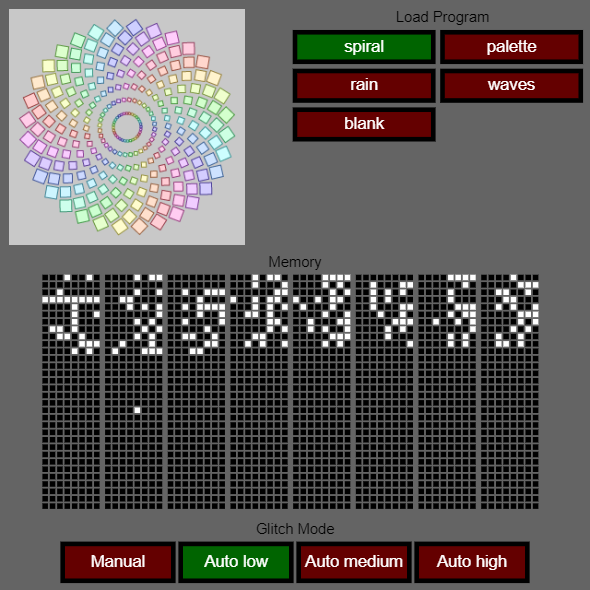
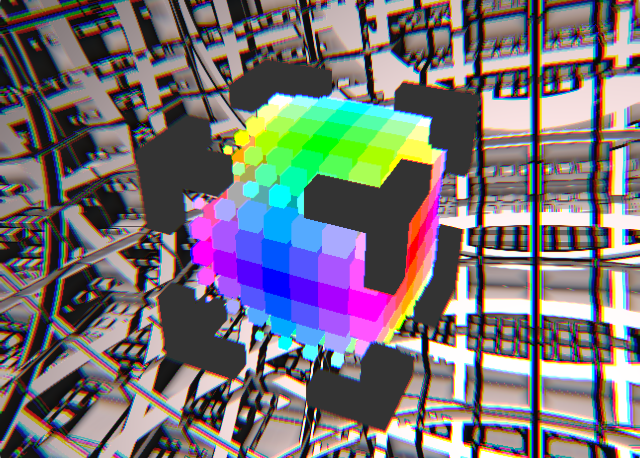
Recently I’ve been playing around with writing some VJ software for the PC. I decided to do this after enjoying writing a handful of audio reactive sketches in Processing but then wanting to have something with more control. The other thing that Processing gave me was a desire to complete the project quickly without worrying too much about how well it was engineered. One thing that helped here was that I decided to fit the entire thing inside 64k – I guess you could even call this the spiritual suscessor to my 1KDJ program from last year. With only 64k to play with I didn’t have enough space to add things like giving the user the ability to load their own models, images or effects, or to reconfigure the way that the existing effects are set up. With these deliberate limitations in mind you can think of 64KVJ as a “fixed function” VJ program.
So I grabbed the code from my 64k framework (the one that I used for Transform) and started hacking away. I added Bass to listen to incoming audio and to give me a spectral analysis of the frequencies in the signal. I then use this to modulate the various effects so that, let’s say, the background effect animates faster when it sees loud bass frequencies. I could probably have done the audio input myself (I already have decent enough FFT code in my framework) but, to be honest, the thought of having to deal with Windows audio input was just too much, especially when Bass already exists and does such a good job of it already.

Next up is the control section. There’s a UI for this in a separate window, but the program also responds to MIDI. I bought a cheap MIDI controler with plenty of sliders and knobs (the really rather excellent Korg nanoKontrol) and configured the program so that the whole thing can be controlled directly with it. This means that I can turn effects on and off and chage their parameters using sliders and knobs, which is much nicer than using a mouse. I’m also thinking of possible live use with this program and my days of DJing tell that being able to tweak multiple controls at once will be a win.
The project is currently about 90% complete – I just need to tidy up the window handling code and fine tune the effects and it’s done. However, I have a couple of other, rather more urgent projects to get out of the way first so it’s currently sat on my virtual shelf. I plan to get it out later in the year when I have more time and I’m posting it up here for two reasons. Firstly, it’s a reminder so that I don’t forget about it. Secondly, I’m curious to know whether anyone else in interested in using the program. I would love to see this used live! Give me a shout if you’d love to get involved in making that happen ;)
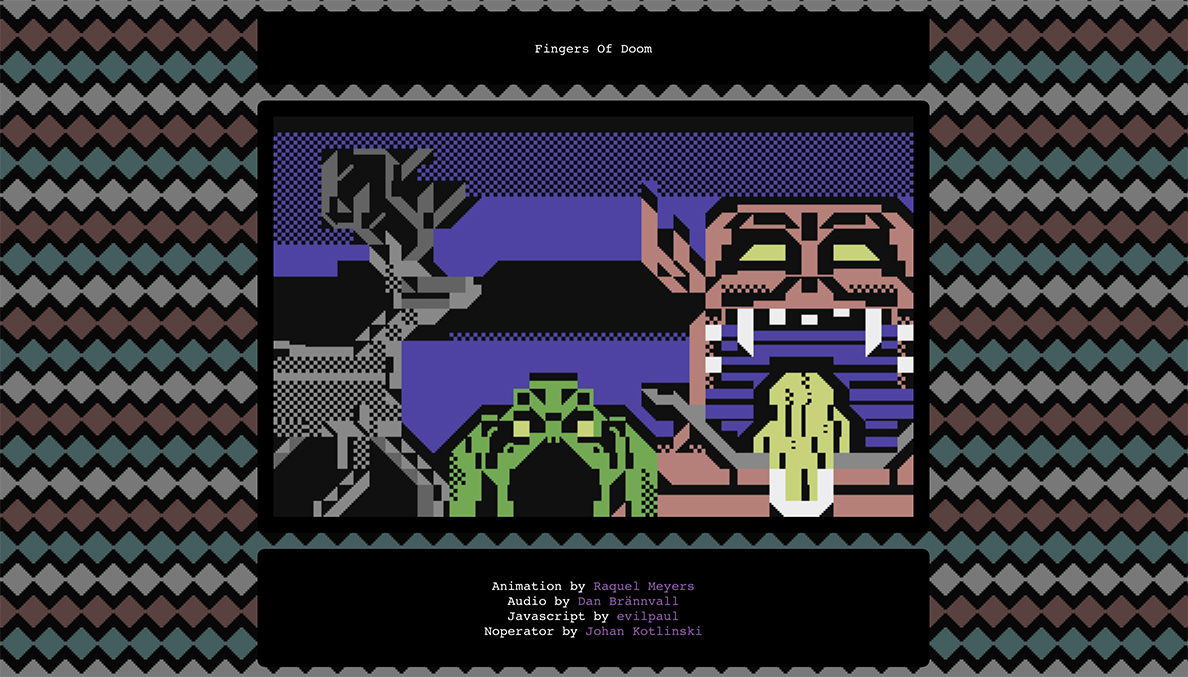
More screenshots of 64KVJ in action after the break..
Read the rest of this entry »
Posted in Computers, Demoscene, Development, Music, atebit | 7 Comments »
June 16th, 2010
Yay. Grab the May edition of Game Developer Magazine and turn to page 5. There you’ll see an editorial piece on the 2010 scene.org awards written by me :)
I’m really pleased that this has come about as I’ve been a fan of GD mag pretty much since I started working in the games industry back in 1997. The magazine is run by UBM, who also produce the mighty Gamasutra and the even mightier (and not just because I occasionally write for them!) GameSetWatch websites.
Posted in Uncategorised | 1 Comment »
June 1st, 2010
Just a quick post this one.. I’ve updated the site to the latest version of WordPress. This seems have have got rid of the spam issues I was having. Presumably I’ll just have to wait for Google to re-index me before the last vestiges of the attack go away.
And to make the post slightly longer.. I’ll say that I really like WordPress! The update process (from my manky old version that hasn’t been updated for ages) was painless and the new version is so much nicer :)
Posted in Site | No Comments »
April 12th, 2010
I’ve still not got the Windows partition on my laptop fixed, so I’ve still got idle fingers that are being channelled into writing music visualisers with Processing. This one was created during Friday’s commute to and from work.

Posted in Computers, Development, Music | 2 Comments »
March 26th, 2010
I’ve recently being playing with Processing. It’s described as “an open source programming language and environment for people who want to program images, animation, and interactions“, and it aims “..to serve as a software sketchbook and professional production tool.”
So what does this mean to me? In short it means that I can quickly write some cool looking music visualisers and, because Processing is rather friendly, I can easily export them so that they run in your web browser! Below are three sketches that I’ve written in the past week or so of my Processing experiments. Click on the images to (fingers crossed!) run them. I say “fingers crossed” because the browser implmentation of Processing seems a bit flaky – sometimes I get errors, sometimes I get nothing and sometimes, if I’m lucky, the things even run perfectly. If you do get problems, please just keep trying!


Why all the interest in Processing then? Well, I’ve heard about it a lot over the past year or two. It seems that quite a few digital artists have picked it up and are running with it, and I keep thinking that I too should take a look sooner or later. It turned out to be sooner, when the Windows partitiion on my Macbook Pro stopped working. I do most of my coding in Windows, so this brought an abrupt end to all of that. Luckily, not only was my OSX partition was still fine but the Processing IDE is Mac friendly.
Processing has proven incredibly easy to get into. It’s Java based and comes with not only a simple IDE but also a huge number of libraries, examples and tutorials. The online support forums and reference guides are also pretty impressive.The language itself is definitely geared more towards experimentation and learning than development of full-blown applications. The fact that Processing programs are called “Sketches” makes that obvious from the start. I’ve certainly found it liberating to work in such an experimental fashion, though, and I’ll probably be incorporating some of things I’ve learned back into my main codebase when I finally find the time to reinstall Windows. Will I continue to play with Processing when that’s done? Yeah, I probably will. The speed with which I can code these sketches can be very impressive. The second and third sketches above only took about half a day’s work each, and they are the perfect antidote to working on large-scale projects.
Posted in Computers, Development, Music | 4 Comments »
March 17th, 2010
My 64k intro from last year, Transform, has been nominated in the category of “Best 64k Intro” at this year’s Scene.org Awards. Yay! :)

Edit: Hang on! Just the one nomination this year? We must be slipping… ;)
Posted in Uncategorised | No Comments »
March 8th, 2010
At the end of last year I visited the Decode: Digital Design Sensations exhibtion, held at the V&A in London. The event “showcases the latest developments in digital and interactive design, from small, screen-based, graphics to large-scale interactive installations”. There were certainly some great pieces at the event (such as the works by flight 404 and Matt Pyke, for example) but a lot of it really left me with the feeling that I could have done it. In fact, I began thinking that I should be doing it.
One of the pieces at the event was the exhibition’s digital signature itself, designed by Karsten Schmidt. The piece is written in the Processing language and the code is available for download. This means that the piece is open for remixing. Actually, both the author and the event’s organisers actively encourage you to remix the piece and submit your results for inclusion in their online gallery.
After a discussion with Matt “Smash” Swoboda we both decided we’d have a go, but as we didn’t like the look of any of the existing remixes (change the colours, change the camera, job done..) we thought we’d recode them ourselves from scratch instead. Matt went for an incredibly high-end PC version, while I went in the complete opposite direction and produced a 512byte ZX Spectrum version.

The important part of this project for me was to produce the work on the same 1980’s technology that I used for my first experiments in digital art all those years ago. I think that back in those days, almost everyone who had a home computer was inspired to produce art with it to some degree – even if it was just typing in a program listing from the back of the manual. Others were inspired to copy what computer graphics we saw on TV or in the cinema. Of course the end results were nothing like the amazingly advanced (for their time!) inspirations, but they took on a charm of their own. These investigations and experiments were what eventually led me to the demoscene.
I took what I considered to be the key elements of the original piece (the obscured logo, the angular graphics, and the waves of vibrant colour) and boiled them down into the smallest amount of code that I could. The end result fits into just 512 bytes and runs on an original 48k ZX Spectrum.. or an emulator.
You can find the video over on: Vimeo
You can also download the executable and full source code from: atebit.org
Posted in Computers, Demoscene, Development, atebit | 2 Comments »
February 12th, 2010
Whenever I’m writing a demo (or a game, or anything) I usually collect copious amounts of reference material. Some of this directly influences my work, some of it doesn’t. The stuff that isn’t of immediate use often gets lost and forgotten, and I find this a shame – sometimes, maybe months after discarding an idea, a use for it will pop into my head.
I’ve had it in mind for a while now to start a site where I can collect these pieces of inspiration together in one place, to create an archive that I can browse back through when I’m in need of a creative spark. And now, finally, I’ve created bitethis.org as a place to do just that. In case you were wondering, the name is slightly tongue in cheek – in rap parlance bite means to copy or steal someone’s style, particularly their lyrics.
So, bitethis.org aims to be a catalogue of inspiring videos, pictures, interviews, music, games and, well, anything else that either influences me or makes me want to create something. The aim is to post one inspiring thing every single week day.
It’d be rude if I failed to mention Matt Simmonds at this point – the initial germ of the idea for the site came when he and I were swapping references for demo design. Matt has already been very active in helping me collect enough material to get the site started. Thanks Matt!
So please check out the site, and I hope that it proves as inspiring for other people as it does for me.
bitethis.orgĀ
Posted in Demoscene, Development, atebit | No Comments »
February 3rd, 2010
I’ve been writing the odd small piece for GameSetWatch recently. This site is a weblog run by the staff of Think Services Game Group. No, I don’t recognise the name either. But I do know the names of two of their most important services: Gamasutra and Game Developer Magazine. Both of these stand out in the game development industry as excellent resources and I’ve been a fan for over a decade. It’s a real honour to now be writing for their “alt.videogame” site.
I’ve recently started a round up of the 2009 demoscene on GSW. This is quite a large topic so it’s been split up into several, smaller pieces. Here are the two articles that have been published so far:
Special: The Best Of The 2009 Demoscene, Part 1 – Demos
Special: The Best Of The 2009 Demoscene, Part 2 – 64k and 4k
Posted in Computers, Demoscene | No Comments »
October 1st, 2009
Demovibes is a rather awesome series of mixed compilations of demoscene music. If you’re feeling in the need for some good electronic music to listen to then give them a go – whether you know anything about the demoscene or not you’ll find some great music.
Anyway…. volume 9 is out today and, well looky here, there’s an Ate Bit track on the playlist. Congrats 4Mat! ;)
Posted in Demoscene, Music, atebit | No Comments »